Real talk with business leaders preparing for 2030.

How This Company Scaled to 80+ Clinics With Zero Acquisitions [Ft. Costello & Rogers, Spear PT]
Spear Physical Therapy scaled from four locations to 80-plus with no acquisitions and no outside leadership hires. Every clinic director comes through a year-long internal program, and new clinics open around a leader who is already ready, not the reverse. That program ends in a peer-judged pitch competition the company funds, the source of Spear's at-home service line and women's health program.

Why Taste Is the One Thing AI Still Hasn't Replicated [Ft. Jared Tredly, Shopify]
AI raises everyone to an 8 out of 10. Jared Tredly's read is that the premium then moves to whoever pushes that 8 to a 10, because taste is the part AI hasn't replicated. That same floor-raising is dissolving role boundaries and shrinking teams across every function, not just design.

B2B marketing in 2030: How domain signals replace the lead [Ft. Emma Robinson, Canva]
Canva runs account-based marketing across a thousand accounts, producing custom copy, images, and a personalized landing page for each, with the company name and a tagline in every asset. Emma Robinson, Head of B2B Marketing at Canva, tells Keith how product usage signals, CRM, and sales-call data feed the creative to make that scale work.

How This Private Equity Firm Went All-In on AI in One Year [Ft. Jarrad Berman, TZP Group]
A year ago, TZP Group had zero AI licenses. Within days of Claude's Excel plugin launching, employees who had resisted every tool started demanding access, and that consumer pull became the firm's adoption engine.

How This Software Founder Is Rethinking Development for the Future [Ft. Slava Khristich, Tateeda]
Slava Khristich has run a software firm for 13 years, and he argues the buy-versus-build math that ruled enterprise software for decades is now inverting. After hitting a functionality wall with HubSpot, he took screenshots and had a working CRM running in his own environment a week later.

How This MRD Testing Pioneer is Preparing for the Future [Ft. Jeffrey Miller, Invivoscribe]
What happens when you spend three decades perfecting cancer diagnostics without ever taking a dollar of venture money? At Invivoscribe, it means building what Peter Thiel calls a complex coordinated business, the same category he places Apple in, one too slow to mature for VC funding but built to compound for decades.

How to Build and Sell a Performance Agency for 9 Figures [Ft. Steve Weiss, MuteSix]
Steve Weiss built MuteSix into one of the most competitive performance marketing agencies in the country and sold to Dentsu for a little north of $100M. In this episode, Steve joins Grayson Lafrenz, Founder and CEO of Cadre AI, to get into what agency owners consistently get wrong about AI adoption, why most companies can't point to AI actually showing up in their P&L, and where the real operating leverage will come from as teams get smaller and output expectations go up.

Why Pure SaaS Is Dead for Investors (And What's Next) [Ft. Neal Bloom, Rising Tide Partners]
Neal Bloom spent a year on the sidelines from 2023 to 2024, passing on nearly every software deal because he couldn't figure out how to underwrite pure SaaS to 100x anymore. That pause pulled him toward hardware, and what he found changed how he thinks about where returns actually come from now. As Managing Partner at Rising Tide Partners, and with roughly 70-80 investments behind him across angel bets and Interlock Capital, he has a sharp and specific point of view on what's worth backing and what isn't.

How Two Sommeliers Are Disrupting a $90B Industry With Cans [Ft. Zeke Blattler, Los Cuernos Wine]
Zeke Blattler, Co-Founder & CEO of Los Cuernos Wine, is running a two-person company gunning for a $100-300M exit — and his argument for why that's achievable without a large team is one of the more clear-eyed takes on company building you'll hear. With $90 billion in revenue locked inside glass bottles and an aging consumer base, he saw a structural window most incumbents are too slow to act on. The strategy he and co-founder Cory Assink built to get there is specific, counterintuitive, and worth studying regardless of what industry you're in.
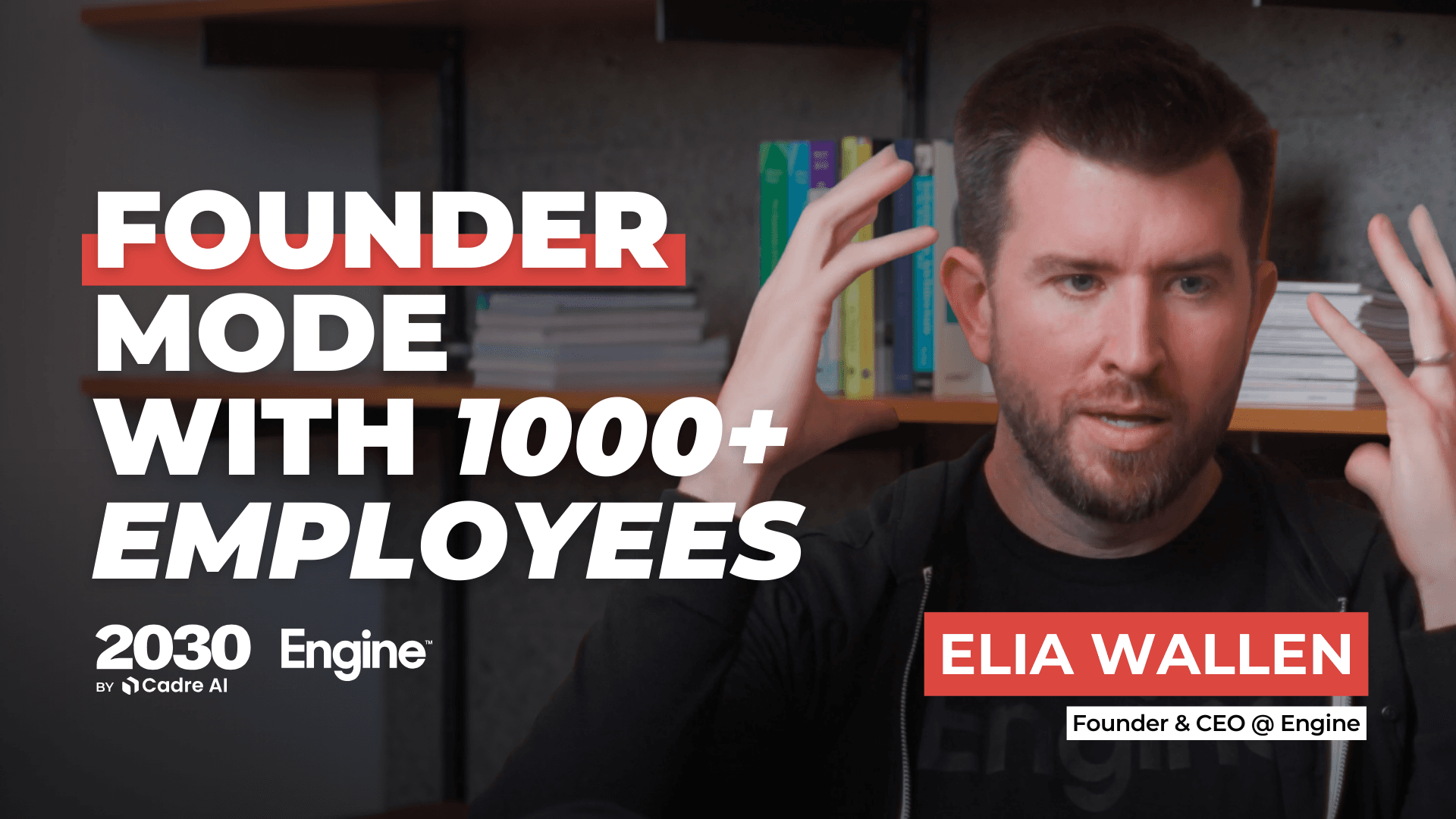
How This $2B+ Technology Company is Preparing for the Future [Ft. Elia Wallen, Engine]
Most boards pressure founders to reduce direct reports as they scale. Elia Wallen took the opposite approach: he manages 15 direct reports while growing Engine past 1,000 employees to a $2.1B valuation, and he eliminated the Chief Product Officer role entirely. His logic: additional management layers slow decision-making when speed matters most. When you build talent density and restructure one-on-ones around problem-solving instead of status updates, you can operate with higher spans of control.
Track your AI results