The State of AI in Construction
A field report for presidents, owners and COOs of general contracting and building firms. Built from 40 cited sources: industry surveys, federal data and the published record of the contractors already deploying AI.
Contractors under $50M have been lagging on AI adoption.
Two years ago, 30% of contractors told the Associated General Contractors of America they planned to invest in AI. Last year it was 44%. In the January 2026 survey of 951 firms, 61% said they either use AI today or are increasing what they spend on it. [S1][S2] Almost half already run AI in the back office. [S1]
For a $30M to $500M general contractor, the key finding is that AI adoption differs by firm size. Among firms with $50M or less in revenue, half did not initiate or increase AI use in any function in the past year, against 39% of all firms. [S3] Large contractors are more convinced that AI will give them a competitive advantage (86% versus 69% of small and mid-sized firms) and far less likely to see cost as a barrier (26% versus 49%). [S4] Backlog also differs by firm size. Contractors over $100M in revenue hold 12.1 months of backlog. Contractors under $30M hold 7 months. Contractors between $30M and $50M in revenue now have their lowest backlog since March 2020. [S5]
By firm size, the bands with more months of backlog are the ones adopting AI faster. The backlog figures and the adoption figures come from different surveys, so they do not show whether the firms with more backlog are the same firms adopting AI.
This report does four things. It sets out the margins, costs, payment waits and backlog a mid-size GC is working with in 2026. It names contractors of every size that already use AI, with their published results. It explains why so many AI efforts in construction stall before they pay back. It also names the six use cases that we see pay back first. All six start from data a GC already has.
- 01Input costs rose 7.1% in the year to June 2026. Bid prices rose 3.5%. AGC's read is that contractors absorbed much of the difference. [S7]
- 02Subcontractors wait about 50 days to be paid. Owners pay general contractors in a median 17 days. Subcontractors wait roughly a month longer for payment than the GC does. [S8][S9]
- 03The typical construction firm runs ten software applications. Among commercial specialty contractors, only one in five operates on a single platform. Reporting is built by hand because the systems a firm already has are not connected. [S10][S11]
- 04Regional builders, as well as the ENR Top 20, already use AI on real work. A Texas GC built its own AI assistant for 650-plus employees. A $200M GC automated WIP reporting. A specialty contractor cut accounts-payable processing from between 30 and 35 hours a week to 2.5 hours. [S20][S24][S27]
- 05AI pilots stall because of poor data. 57% of contractors cite unreliable or inaccurate AI output as a concern. Only 26% rate their own data quality as high. AI output is unreliable when the data it works from is unreliable. [S4]
- 06The use cases that pay back first are in finance and operations. They use data from the project management system and the accounting system. Connecting those two systems comes before buying any new software.
Profit fade found at month-end close is too late to fix.
The 2025 CFMA Construction Financial Benchmarker, built from the financial statements of 1,558 construction companies, puts net income before taxes at 6.7% of revenue across all participants. For industrial and nonresidential contractors, the category closest to a commercial GC, it is 4.4%. CFMA's "best in class" cohort, drawn from all participants, earns 12.0%. [S6]
For a $100M general contractor, a 4.4% margin is $4.4M of pre-tax income. CFMA's best-in-class margin of 12.0% would be $12M on the same revenue. The best-in-class cohort is drawn from all CFMA participants, so it includes firms outside industrial and nonresidential work. Part of the difference between those two margins is earned in the field. Another part is earned in the office, by knowing in week three of the month, before the month-end close, which cost code on which job is running over budget.
Input costs in 2026 are rising faster than bid prices, which cuts into contractor margins. In the twelve months to June 2026, the producer price index for construction inputs rose 7.1% while bid prices for new nonresidential buildings rose 3.5%. [S7] AGC's own summary: contractors continue to absorb much of the increase in materials costs. Seventy percent of contractors surveyed in late 2025 said tariffs had affected them. Forty percent raised bid prices, 35% passed most or all of the cost to owners, and 11% absorbed most or all of it themselves. [S3][S12]
Uneven demand is hurting smaller contractors. AIA's July 2026 consensus forecast has nonresidential building spending down 0.3% in 2026. The panel notes that without data centers, spending would fall roughly 1% this year and rise 1% next year. [S13] Sixty-three percent of contractors had an owner postpone, scale back or cancel a project in the prior six months, most often for lack of funding or financing. [S3]
Backlog figures show larger contractors with more work booked than smaller ones. ABC's Construction Backlog Indicator fell to 8 months in July 2026. Contractors with more than $100M in revenue hold 12.1 months of backlog. Contractors under $30M hold 7. The $30M to $50M band fell to its lowest reading since March 2020. [S5]
A cost overrun caught in week three can still be disputed with a sub or covered by a change order. An overrun found at month-end close has already come out of the job's profit.
Fifty days is the median subcontractor wait for payment.
In Billd's 2026 survey of more than 600 subcontractors, suppliers and GCs, subcontractors report waiting an average of 51 days for payment after submitting a pay application. General contractors in the same survey believe they pay in 35 days. [S8] Transaction data from a construction payments platform, published by that platform, puts the subcontractor wait at a median of 50 days and an average of 57. The same data shows owners paying general contractors in a median of 17 days. [S9] The Billd survey average and the transaction data median for the subcontractor wait are each roughly a month longer than the time owners take to pay the GC.
CFMA's benchmark puts days in accounts receivable at 55.2 across its 1,558 companies. [S6] Ninety-two percent of subcontractors in a Siteline survey floated payroll out of their own pockets in the past year while waiting to be paid, and 28% did so in most months. [S14] In the 2025 edition of the same survey series, general contractors reported spending 73 hours a month on payment workflows, up 26% year over year. [S15]
The delays in payment come from specific errors and slow steps in the back office. A change order is approved in the project management system and never booked in accounting. A commitment shows one amount in the project management system and a different amount in accounting. A pay application packet takes a full day to assemble by hand. Each of these delays comes from job data that is missing, mismatched or gathered by hand. Data problems like these are where contractors have started to see results from AI.
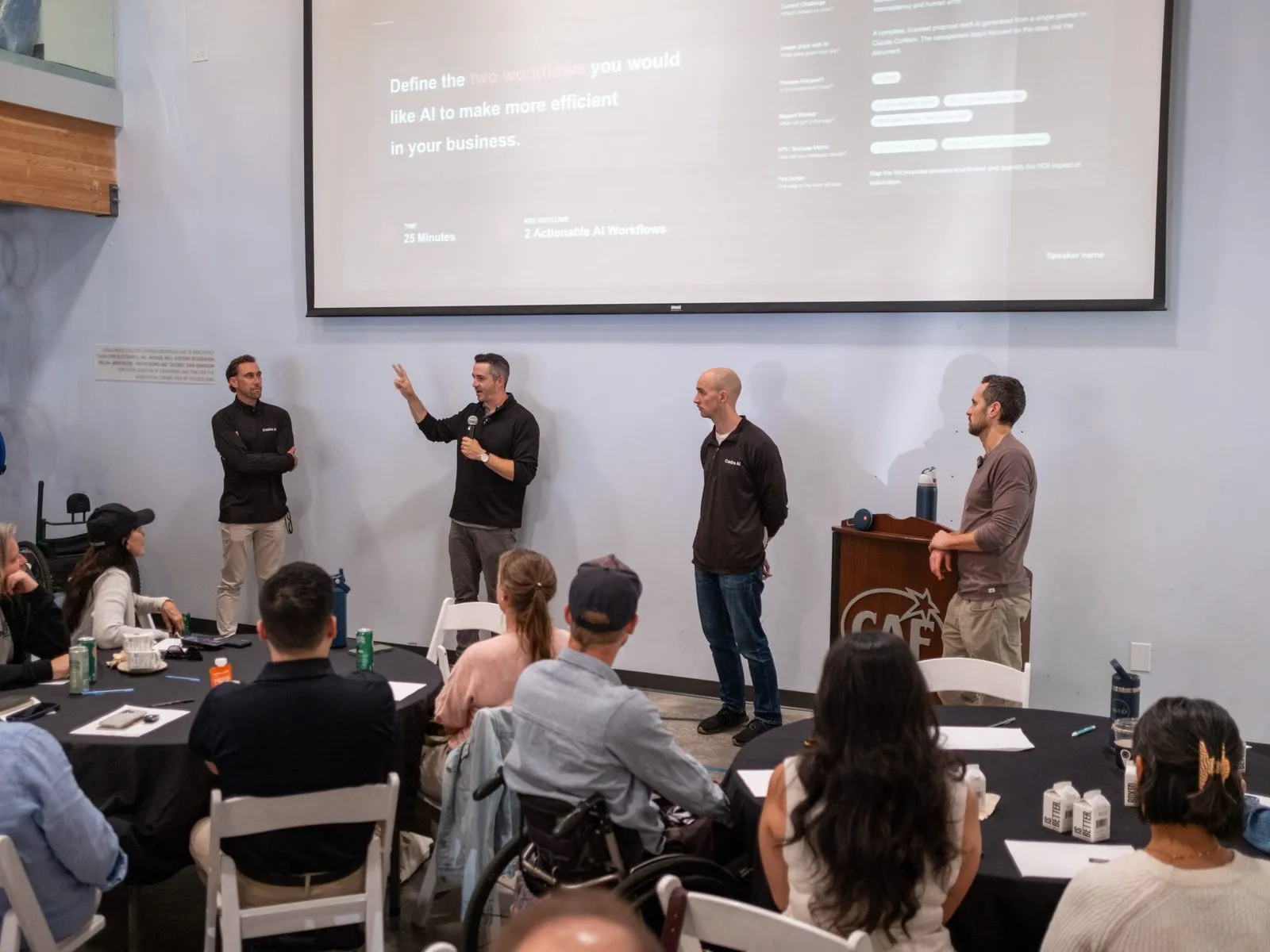
Each department learns AI on its own real tasks.
Cadre trains executives first. Next, the whole company gets the same basic AI training. Then Cadre works with each department on the real tasks that team does.
See how the training runsAccountants still piece together every job's real numbers by hand.
In a vendor survey that does not disclose its sample, the typical construction firm runs ten software applications, 75% of decision-makers say disconnected systems make them spend too much time managing data, and 92% say they want a single integrated platform for projects and financials. [S10] Among commercial specialty contractors, only 20% actually operate on one. [S11] In a July 2026 survey of 308 construction and real estate executives, 59% reported full or extensive integration between their systems. In the same survey, 30% met the criteria for high technology maturity. That survey counts integration system by system and does not check whether the numbers in the systems agree. [S16]
Disconnected and unreliable data costs contractors staff time. Procore's 2025 survey of more than 1,200 construction decision-makers across eight countries found 18% of project time is lost searching for data and 28% is wasted due to rework. [S17] In Autodesk and FMI's 2021 global study of more than 3,900 professionals, using 2020 data, only 12% said they always incorporate project data into decision-making, and 30% said more than half their project data is bad, meaning inaccurate, incomplete, inaccessible, inconsistent or untimely. [S18]
At a general contractor, the budget is kept in the project management system. The actual costs are kept in the accounting system. The two systems were bought for different purposes. They were never built to talk to each other. So somebody, usually a project accountant or a project executive, compares budget against actual cost for every job by hand in a spreadsheet, typically at the end of the week. By Monday morning the crews have spent more money. The spreadsheet no longer shows the current cost of each job.
The weekly spreadsheet is expensive clerical work, because it takes time from the people who manage the jobs. Disconnected systems are also the reason AI has done little for job cost reporting so far. AI cannot work with data kept in a system it is not connected to. Its answers cannot be trusted when nobody has reconciled the numbers in the two systems.
Eight percent of the trades use AI in their everyday work.
Survey numbers on AI adoption in construction range widely, from 1.4% upward, depending on what is being counted, and on whether the question asks about production use, any use, or any tool with an AI feature in it. This report uses the strict reading of each source and says what each number measures.
The AGC and Sage outlook is the best long-running survey series for US contractors. Of its 951 respondents, 83% are under $500M in revenue. In the 2024 outlook, 30% planned to initiate or increase AI investment. In 2025 it was 44%. In 2026, 61% said they use AI or plan to increase investment in it. [S1][S2] The same survey gives the clearest available figures on where contractors are putting AI to work. In the past year, 45% initiated or increased AI use in office applications. About one in five did so in estimating, about one in five in design or preconstruction, and 16% in recruiting, training or HR. AGC's narrative report gives estimating 23% and design or preconstruction 20%, and its response tables give the reverse, so this report gives each as about one in five. [S1][S3]
Dodge Construction Network's late-2025 survey of 235 US general and trade contractors found 87% believe AI will have a meaningful impact on construction, 51% are actively evaluating AI-related changes, and 40% have a dedicated AI budget. [S4] A dedicated AI budget is the strongest sign in these surveys that a firm has committed to AI.
A growing share of contractors now report results from AI. In ServiceTitan's 2026 survey of more than 1,000 commercial specialty contractor leaders, the share reporting measurable business impact from AI rose from 17% in 2025 to 38% in 2026. Each respondent decided what counted as measurable impact, and no one audited the answers. [S11] Globally, RICS reports that regular AI users among construction professionals rose from 12% to 19% in a year. On RICS's own definition, roughly two-thirds now use AI in some form. RICS widened that definition between the two editions, so the two-thirds figure counts more kinds of AI use than the earlier edition did. [S21]
AI use on the jobsite is low compared with what trade workers expect. In DEWALT's August 2026 survey of 2,481 US trade workers and decision-makers, 8% use AI in their everyday work. In the same survey, 90% believe AI will be indispensable within five years, and 83% expect it to be standard within three. [S22]
Run the six use cases on the firm's numbers.
Cadre connects the project management system, the accounting system, and payroll so they share one set of numbers. Cadre then builds reports, estimating tools, and subcontractor records from those shared numbers.
See the six solutionsAI is arriving inside the software mid-market contractors already own.
Every survey that splits its results by firm size finds larger contractors further ahead on AI than smaller ones.
Large contractors are more convinced: 86% say AI will give them a competitive advantage, against 69% of small and mid-sized firms. They are less cost-constrained: 26% of large firms call implementation cost a problem, against 49% of smaller firms. [S4] Among AGC respondents with $50M or less in revenue, 50% selected "none of the above" when asked whether they had initiated or increased AI use in the past year. Nationally the figure is 39%. [S3] In McKinsey's survey across all industries, 40% of large enterprises are now scaling AI agents, up from 27% a year ago. Smaller organizations stayed flat at 22% over the same year. The gap between large and small organizations grew over that year. None of these McKinsey figures is specific to construction. [S23]
Backlog by contractor size is reported in Section 01. The revenue bands holding 12.1 months of backlog are the bands where adoption is highest. The bands holding 7 months are where it is lowest. Separate surveys of backlog and of AI adoption both rank the largest contractors first and the smallest last. Waiting on AI spares a smaller firm the implementation cost this year. Over the longer term, waiting keeps the firm closer to the typical industry margin than to the best-in-class margin.
The large construction software vendors, including Procore, Trimble and Autodesk, are adding AI to the software that mid-size contractors already use. Procore's agent library reached 20 agents in July 2026. [S32] Trimble has agreed to acquire Document Crunch, an AI contract review tool already deployed on more than 10,000 projects. The deal was expected to close in the second quarter of 2026. [S31] Autodesk closed its purchase of Rhumbix. Autodesk has also agreed to acquire MaintainX for $3.6 billion. CEO Andrew Anagnost said the deal is about the data that gives AI the context to be accurate. MaintainX makes software for maintenance and facilities operations, which is a separate field from project delivery. The terms of the two deals closest to contractor work, Trimble's purchase of Document Crunch and Procore's purchase of Datagrid, were not disclosed. [S30][S39] AI contract review, submittal review and document search will be added to the software a firm already uses, whether or not the firm asks for them. The open question for leadership is whether the firm's job data is reconciled well enough to trust the answers those AI tools give.
Regional and mid-size builders already run AI on real work.
The examples below are drawn from trade press, company announcements and published customer case studies. Where the only source is the vendor and its named customer, the entry says so. Figures are given as published. Where a published figure is itself an annualized or vendor-calculated estimate, the entry says so.
Staff ask an in-house AI instead of digging through policies and project files
Rogers-O'Brien ConstructionTexas regional GC, ENR #74, 650-plus employeesCompany-reported: 5,600-plus queries processed and up to 50 minutes saved per complex task.
Skanska USA BuildingNationalMore than 1,000 users across more than 500 projects since the 2024 pilot.
Turner ConstructionNationalTurner's AI safety assistant logged more than 25,000 interactions before Turner released it free to the whole industry in May 2026.
Gilbane Building CompanyNational, $8.7BA 37-day document-AI pilot fielded 246 staff queries across 20,600 documents and returned 6.5x on labor by the vendor's calculation.
The WIP report and the invoice pile run without a spreadsheet
Bayley Construction$200M GC, Washington, Southern California and ArizonaVendor case study; no percentage published.
Metro WallsSpecialty contractor, grew from $10M and 25 employees to more than $100M and 250 employeesIts CFO's words: "This has bought me back a week of my time every month." Vendor case study.
O'Shea BuildersGC founded in 1900, one of the oldest in the countryThe time to load an estimate into the job budget fell from 40 days to 9 days. Field teams received budget data in 0.3 days instead of an average of 20.
Accel Air SystemsSpecialty mechanical contractorThe time spent on AP processing fell from between 30 and 35 hours a week to 2.5 hours, about 2.5 minutes per invoice.
Estimators finish takeoff with a tenth of the effort
Coastal Construction GroupSoutheast GC, 400-plus employees14.5 hours saved per plan set, which the case study annualizes to about 13,920 hours and roughly $1M.
Hill & WilkinsonTexas GCDocument review ran 75% faster. The time to onboard new staff to document review fell from days to hours.
Consigli ConstructionFamily-run, $4B-plus annual volumeMoved 80 to 100 estimators onto AI-assisted takeoff.
One job proved the savings before anyone rolled it out
Hensel PhelpsNational2,964 hours of manual coordination eliminated and $342,000 in verified labor savings on one $300M airport project.
Novo ConstructionRegional California GCNo quantified result published.
Several of these firms are regional builders. The ones that publish revenue include a $200M GC and a specialty contractor that crossed $100M. Most of the firms above started using AI on one specific task, such as WIP reporting, invoice processing, takeoff or safety questions.
77% of construction tech venture capital went to AI in 2025.
A growing share of construction technology venture funding goes to AI-enabled companies. On Cemex Ventures' own tracking and classification, AI-enabled companies took 35% of ConTech venture capital in 2024. In 2025 they took 77%, or $5,051 million. Roughly 70% of ConTech transactions in the first half of 2026 involved an AI-enabled startup. Total ConTech venture capital in that half-year was down 19% from the same period in 2025. [S36]
The large construction software vendors are acquiring companies to bring AI into their products. Procore acquired AI-agent company Datagrid in January 2026. [S39] Trimble announced the acquisition of Document Crunch in April 2026. [S31] Autodesk closed its purchase of Rhumbix in March. In May, Autodesk announced a $3.6 billion all-cash acquisition of MaintainX. Autodesk described MaintainX's operational data as "the context needed to make AI accurate, actionable, and valuable." [S30]
For a mid-size GC, these deals mean AI tools will arrive inside software the GC already pays for. The vendors will not supply clean, connected, reconciled data about the GC's jobs. The GC has to connect and reconcile that job data itself.
Your AI model is rarely the problem. Your data almost always is.
Contractors say their biggest worry about AI is that its answers will be wrong. Fifty-seven percent cite lack of reliability or accuracy in AI results as a concern, the highest of the barriers Dodge reports. In the same survey, only 26% rate their own data quality as high. [S4] The low data quality explains the unreliable AI answers. AI reasoning over a budget in one system and actuals in another, with cost codes that do not match, produces unreliable answers because the inputs were never reconciled.
RICS puts integration and data quality near the top of its own barrier list, across 2,200-plus professionals globally (48% UK, 10% Americas): skilled personnel 46%, integration with existing systems 37%, data quality and availability 30%, implementation cost 29%, unclear ROI 28%. [S21] Only one in five commercial specialty contractors operates on a single platform. [S11] Training is underfunded at most firms: 65% of AEC firms spend less than 10% of their technology budget on it. [S37]
DPR Construction published its own account of the roadblocks it hit when adopting AI. Its three roadblocks were data quality, meaning inconsistent collection and storage across systems; cybersecurity policy that was either too restrictive to allow experimentation or nonexistent; and a wide gap in digital comfort across the workforce. Its response was a leadership steering committee to pick pilots, enterprise licenses, and permission for hesitant employees to experiment with AI under company rules. [S38]
Across all industries, far fewer organizations report profit from AI than report using it. McKinsey's 2026 global survey found about 89% of organizations use AI in at least one function, 37% report any EBIT impact, and 6% qualify as high performers with 5% or more of EBIT attributable to AI. Those last two figures did not move in a year. [S23] Getting profit from AI requires connecting and reconciling the data it works from.
More on Procore and the accounting system
Staff still check some job data by hand every day after a Procore accounting integration is installed.
The weekly job cost report is several days out of date by the time anyone reads it.
Six use cases that grow margin, free cash, and save staff time using your firm's current data.
These six are the use cases we see pay back first at general contractors and builders, in roughly this order. None of them needs new field software. All of them run on data the company already has. Each one starts working after the project management system and the accounting system are connected and reconciled on project number and cost code.
01One view of every project's budget and actuals
02Catch what your two core systems disagree about
03What a job really cost, including labor
04Let estimators see what past jobs actually cost
05Score your subcontractors on their actual record
06Add up all your entities into one view
All six use cases run on one governed data warehouse. Every night, the warehouse pulls data from the project management system, the accounting system, payroll and the other tools. The warehouse reconciles that data on project number and cost code. The reconciled data is stored in one place. Row-level permissions let each person see only the data that belongs to them. The warehouse is SOC 2 and HIPAA compliant, so payroll detail, lender packets and reports to project owners can sit in one governed environment.
Once the warehouse is running, leadership can ask it questions in plain language.
The answers come from numbers that have been reconciled across systems. Every result in this section depends on building the warehouse and reconciling the data in it. That work takes 60 days, running from day 60 to day 120 of an engagement, once the AI strategy is set. Once the cost code mapping between the systems is agreed, two of the six use cases above typically go live in that period. In some engagements, three go live.
Six boxes every contractor needs to check before winning with AI.
- 01
A named person accountable for it
Where Section 06 names a person, it is always someone with a title and a mandate: a CIO, a Chief Innovation Officer, a Chief Strategy Officer, a CFO. A daily list of missed entries goes unread unless a named person is responsible for clearing it. - 02
A business case made on cash
A subcontractor who cannot bill against an unbooked change order waits longer to get paid. That delay also strains the subcontractor's relationship with the GC. Cash collected or paid sooner matters more to a contractor's leadership than staff hours saved. - 03
Project management and accounting connected first
The unreliable AI answers described in Section 08 come from job data that was never reconciled. The first task is to map project numbers and cost codes between the project management system and the accounting system. That mapping has to be planned and staffed as a task of its own. - 04
One job as the first proof
- 05
A governed place for staff to try AI
DPR issued enterprise licenses specifically so hesitant staff could try AI under company rules. [S38] Haskell chose a permissive AI governance policy over a ban. The firm reports cutting submittal review from seven days to ten minutes with AI. [S40][S32] Sixty-five percent of AEC firms spend less than a tenth of their technology budget on training. [S37] A firm that spends that little on training gets nearly as little from AI as a firm that has not adopted it. - 06
A person approving every AI action
The AI flags possible errors, and a person decides which ones to act on. The AI cannot change any record in the project management system or the accounting system until a person approves that change. Because a person approves every change, a firm can start using AI quickly without risking wrong entries in its job records.
Systems connected and savings made within the first 120 days.
The hardest requests, such as AI that estimates from drawings or AI that runs the schedule, go on the phase two roadmap, written down as the team described them. Both need the connected, reconciled data that phase one builds. A more capable AI does not replace that data.
Start where the data already is: project management, accounting, payroll.
Every use case in this report starts from data a general contractor already owns: the project management system, the accounting system, and payroll. Cadre connects the three systems. It then builds the reporting, estimating, and subcontractor records from that data. Each department is trained on the reports it will use.
Methodology and cautions
Sources
- S1AGC of America and Sage, "2026 Construction Hiring and Business Outlook," January 2026. n=951 US firms, fielded November 4 to December 15, 2025. 49% of respondents at or under $50M revenue, 34% at $50.1M to $500M. agc.org
- S2AGC of America and Sage, "2025 Construction Hiring and Business Outlook," January 2025 (44% will increase AI investment; 30% in the prior year's survey). n=1,109. agc.org
- S3AGC of America, "2026 Construction Outlook: $50 Million or Less Survey Results" and "National Survey Results," January 2026. Under-$50M segment: 463 respondents (AI question n=458; tariff question n=460). National AI question n=857; national tariff question n=869. US. agc.org
- S4Dodge Construction Network and CMiC, "AI for Contractors," December 5, 2025. n=235 US general and trade contractors, surveyed September to October 2025. constructiondive.com
- S5Associated Builders and Contractors, Construction Backlog Indicator, July 2026 (survey July 20 to August 4, 2026), as reported by Engineering News-Record, August 11, 2026. enr.com
- S6CFMA, "2025 Construction Financial Benchmarker," fiscal year 2024 data, 1,558 companies analyzed. cfma.org
- S7AGC of America, "Construction Input Costs Remain Sharply Higher Than a Year Ago Despite June Decline," July 15, 2026 (BLS PPI analysis). agc.org
- S8Billd, "2026 National Subcontractor Market Report," June 23, 2026. n=600+. billd.com
- S9Built, "Subcontractor Payment Delays: The 50-Day Wait, Measured," August 5, 2026. Platform transaction data, trailing twelve months, retainage excluded. Vendor-published. getbuilt.com
- S10Intuit, construction digital transformation survey, 2025. Sample size not disclosed; vendor-published. intuit.com
- S11ServiceTitan, "2026 Commercial Specialty Contractor Industry Report," March 30, 2026. n=1,000+ commercial construction contractors and specialty trade leaders. Vendor-published; "measurable impact" is respondent-defined. forconstructionpros.com
- S12AGC of America, January 8, 2026 release on tariff impacts (70% affected; 40% raised bid prices; 35% passed most or all to owners; 11% absorbed most or all). Under-$50M segment: 12% absorbed most or all, n=460. See S3 links.
- S13American Institute of Architects, "Consensus Construction Forecast," July 20, 2026. aia.org
- S14Siteline, "The State of Subcontractor Billing in 2026," August 2026. n=492 construction finance and operations professionals, surveyed May 2026. Vendor-published. glassmagazine.com
- S15Siteline, "The State of Subcontractor Billing in 2025," August 12, 2025. Vendor-published. siteline.com
- S16Wipfli, "State of Technology in the Construction Industry 2026," July 2026. n=308 construction and real estate executives. wipfli.com
- S17Procore, "The Future State of Construction," April 7, 2025. n=1,200+ decision-makers across eight countries including the US. procore.com
- S18Autodesk and FMI, "Harnessing the Data Advantage in Construction," September 2021. n=3,900+ construction professionals, global, 2020 data. Only the 12% and 30% findings are used here; the release's headline savings estimate is not. autodesk.com
- S19US Census Bureau and NBER, "Tracking Firm Use of AI in Real Time," CES-WP-24-16 (construction 1.4%, information 18.1%, reference period September 2023 to February 2024) census.gov ; US Census Bureau, "Large Firms With at Least 20 Employees Biggest AI Users," May 2026 (information 39.7%, finance 33.9%, national 19.8%, retail about 14%) census.gov ; Federal Reserve Bank of Minneapolis, "AI adoption in business grows steadily but unevenly," 2026 (construction under 10%) minneapolisfed.org
- S20Rogers-O'Brien Construction, "Rogers-O'Brien Construction Sets New Standard with Custom AI Assistant," September 2025. Company-published. r-o.com
- S21RICS, "Artificial Intelligence in Construction Report 2025," September 2025, n=2,200+ global; and "AI in Commercial Property and Construction Report 2026," August 18, 2026, n=3,100+ global. rics.org
- S22DEWALT, "AI in the Trades Survey," August 31, 2026. n=2,481 US respondents (1,730 skilled trade workers, 751 decision-makers). ohiopowertool.com
- S23McKinsey & Company, "The State of AI: Global Survey 2026," August 25, 2026. n=1,719, 97 nations. Cross-industry. mckinsey.com
- S24Briq customer case studies: Bayley Construction briq.com ; Metro Walls briq.com ; O'Shea Builders briq.com. Vendor-published.
- S25Construction Dive, "Skanska's AI 'Sidekick'," May 21, 2025 constructiondive.com ; Construction Owners, "Skanska USA Building creates Digital Transformation team," July 16, 2026 constructionowners.com
- S26Construction Dive, "Turner Construction releases AI safety tool," May 4, 2026. constructiondive.com
- S27Briq customer case study, Accel Air Systems. Vendor-published. briq.com
- S28Construction Dive, Gilbane earnings and AI, June 2026 constructiondive.com ; Trunk Tools pilot on the Baird Center, reported via TipRanks tipranks.com
- S29Togal.AI customer case study, Coastal Construction. Vendor-published. togal.ai
- S30Construction Dive, "Autodesk to acquire MaintainX for $3.6B," May 2026. constructiondive.com
- S31Trimble, "Trimble to Acquire Document Crunch," April 2, 2026 trimble.com ; Construction Dive, April 2026 constructiondive.com ; Document Crunch customer case study, Hill & Wilkinson, December 2025 (vendor-published) documentcrunch.com
- S32Procore, press release on Digital Coworker packages and 20-agent library, July 23, 2026. procore.com
- S33Construction Dive, "Consigli CIO on AI's impact in estimating," April 22, 2026 constructiondive.com ; Togal.AI case study, Consigli (vendor-published) togal.ai
- S34Track3D and Hensel Phelps enterprise agreement, GlobeNewswire, March 10, 2026. globenewswire.com
- S35Construction Dive, "Novo Construction uses AI to compare drawing revisions," August 5, 2026. constructiondive.com
- S36Cemex Ventures, "AI Trends 2026," February 18, 2026 cemexventures.com ; "Construction Tech Investment in Q2 and H1 2026," July 8, 2026 cemexventures.com
- S37Bluebeam, "Building the Future: AEC Technology Outlook 2026," October 28, 2025. n=1,000+ technology decision-makers in five countries, fielded July 2025. Vendor-published. globenewswire.com
- S38DPR Construction, "Roadblocks to AI adoption in construction," December 10, 2025. Company-published. dpr.com
- S39Procore, "Procore Acquires Datagrid to Accelerate AI Strategy," January 20, 2026. Financial terms not disclosed. procore.com ; Construction Dive coverage constructiondive.com
- S40Haskell, "Smart Construction, Smarter Choices: Haskell's Approach to Applying AI." Company-published. haskell.com